ArticlesFebruary 23rd, 2026
Improving return-to-work services for workers with mental injury

The system is failing workers with mental injury
Mental health claims are the fastest-growing category of workplace injury in Australia. In 2023-24, 17,600 serious claims were lodged for mental health conditions — up 161% over the past decade. These claims now represent 12% of all serious workplace injuries, and the median time lost is 35.7 working weeks — almost five times the median for all other injuries.
The cost is staggering, too. Median compensation for a mental health claim is $67,400, four times the $16,300 median for all claims. But the real cost isn't financial. It's human. And the services we've built to support these workers are still, overwhelmingly, designed for bodies — not minds.
Recovery isn't linear — so why are our services?
Traditional return-to-work programs follow a predictable arc. An injury happens. A claim is lodged. A plan is written. Goals are set. Progress is measured against milestones. For a broken bone or a torn ligament, this works well enough. There's a clear trajectory from injury to recovery.
Mental injury doesn't work like that.
When we mapped the current-state claims experience for WorkSafe Victoria, we spoke with over 50 workers, employers, mental health professionals, and insurance agents. What we found was a journey defined not by healing milestones but by shame, isolation, uncertainty, and powerlessness.
Workers described feeling trapped in a system that asked them to prove they were unwell while simultaneously pushing them to get better. The very process meant to support recovery was undermining it — reinforcing the isolation and loss of identity that mental injury creates.
With mental injury claims now accounting for 18% of new WorkSafe Victoria claims and still rising, it was clear the old approaches weren't working.
Connection, not compliance
WorkSafe Victoria recognised they needed a fundamentally different approach. Over 12 weeks, we applied human-centred design methods to redesign the experience — starting with the people the system was meant to serve.
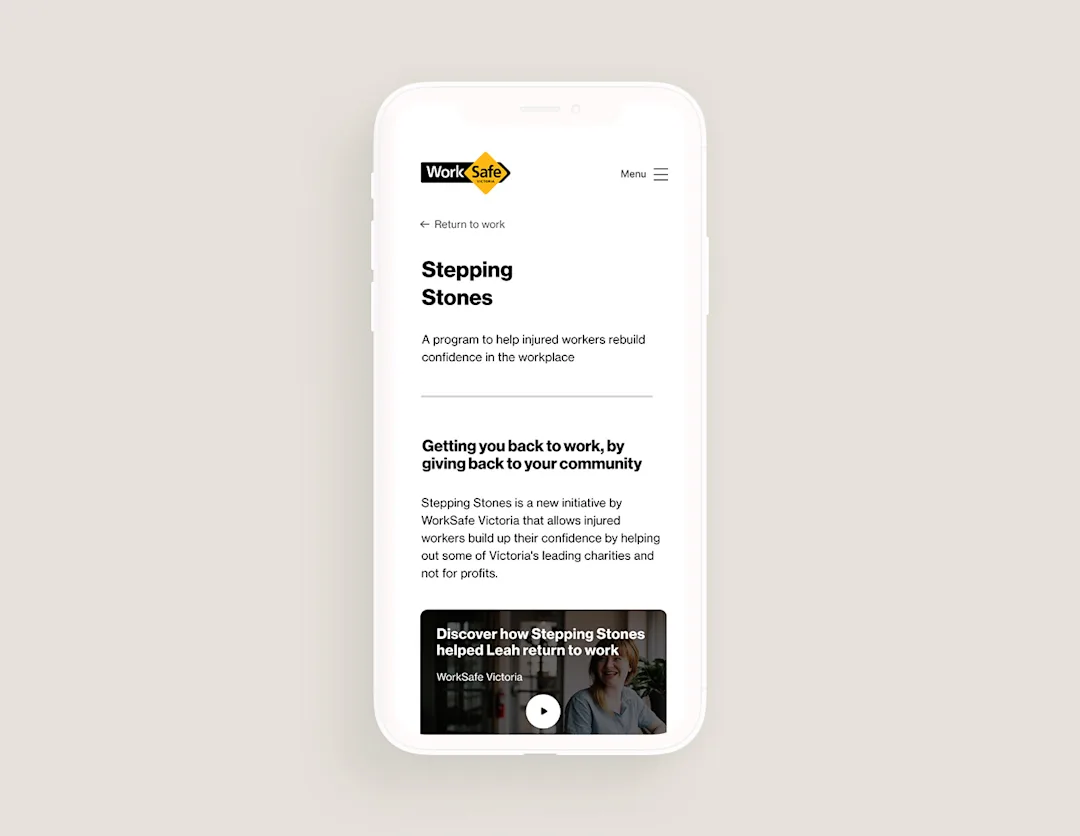
From 28 concepts generated and tested, one rose to the top: Stepping Stones. The idea is simple but radical — pair workers who are ready to re-engage with non-profit organisations across Victoria. Not as employees. As volunteers.
For workers, it's a way to rebuild confidence in a low-pressure environment — without the scrutiny and performance pressure of a formal workplace. For employers, it creates a stepping stone that eases the transition back. For WorkSafe, it pairs two existing services — occupational rehabilitation and volunteer coordination — into something new, requiring no additional resourcing.
Since launching in July 2021, workers have lent their skills to food banks, animal welfare organisations, and charities across Victoria. Many have increased their hours over time, demonstrating growing capacity for routine. Some have been offered paid work at their volunteer placements — a testament to the social value they contribute. The program was recognised as a finalist in the 2023 Victorian Premier's Design Awards for Service Design.
By the time the concept was pitched to WorkSafe's leadership, desirability, feasibility, and viability had already been validated through rigorous design research. They were confident enough to skip the typical pilot phase and move straight to implementation.
What this means for how we design workplace services
Stepping Stones succeeds because it asks a different question. Instead of "how do we get this worker back to their desk?" it asks "what does this person need to feel ready?"
That shift — from compliance to connection, from process to agency — is what's missing from most return-to-work services. And it applies far beyond mental health. Any service designed for people in vulnerable circumstances needs to centre their experience, not the system's convenience.
With mental health claims up 161% in a decade and still climbing, this isn't a niche problem. It's the defining challenge of workplace injury services in Australia. And the lesson is uncomfortable but clear: if your service isn't working for the people it's meant to serve, the problem isn't the people. It's the design.