
Jobs to be done: what are your customers really hiring you for?
Your customers are hiring your product to do a job
People don't buy products — they hire them for the outcomes they need. Every time someone chooses a tool, switches a provider, or builds a workaround, they're hiring something to make progress in their life or work.
When we map the jobs your customers are hiring your product to do, we see your market through their eyes — not as a set of features to compare, but as a landscape of needs:
- Jobs that are well-served — where you're already winning
- Jobs that are poorly served — where competitors are being hired for work you could do better
- Jobs that are invisible — where customers cobble together workarounds because nothing adequate exists
The result isn't a list of features to build. It's a map of where to compete, what to prioritise, and why — rooted in what people actually need.
How we apply jobs-to-be-done
JTBD originated in innovation theory, but the textbook version — job statements and outcome surveys — only gets you so far. We combine JTBD thinking with deep qualitative research to produce something more actionable.
Our approach typically starts with contextual research: observing people in their actual work environments, understanding the systems and constraints around them, and mapping the full landscape of jobs they're trying to get done. We then layer on quantitative methods to validate and prioritise what we've found.
What makes this distinctive is what comes out:
- Visual frameworks that map jobs against complexity, collaboration needs, and tool requirements
- Customer archetypes grounded in shared job patterns rather than demographics
- Strategic roadmaps sequenced around where you can credibly win first and where the bigger bets sit
The output connects directly to product, marketing, and business strategy. It's research that teams can actually use to make decisions.
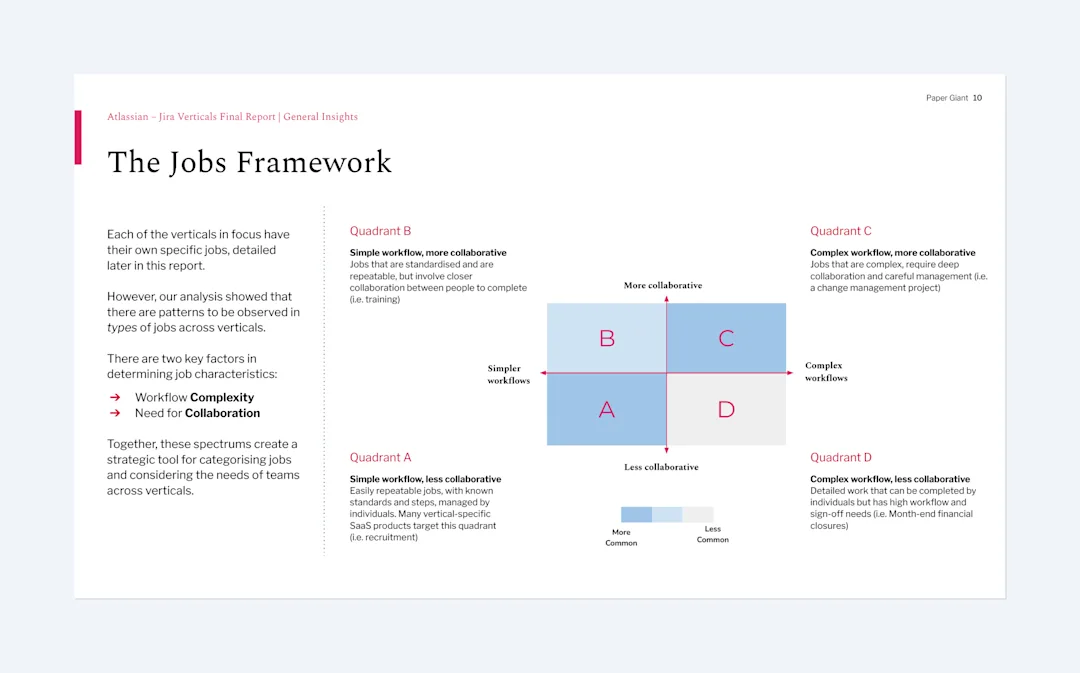
A jobs framework mapping work types across four business verticals, revealing where Jira could expand beyond software teams.
From startup product teams to global SaaS platforms
We've applied jobs-to-be-done across organisations of every scale — from small product teams shaping their first roadmap to multi-national SaaS providers serving millions of users across more than 10 countries. The method scales because the underlying question is universal: what progress are your customers trying to make, and where are they underserved?
We mapped the jobs that HR, Marketing, Finance, and Sales teams hire tools to do — revealing where Jira could credibly expand and where the gap between developer tooling and business reality was too wide to bridge.
From product teams to platform strategy
JTBD's greatest value isn't in feature prioritisation — it's in shaping where an organisation competes. When you understand the jobs across an entire market, you can:
- Sequence investment around where you can credibly win first
- Identify adjacencies that share underlying job patterns
- Build a strategic narrative grounded in customer reality rather than competitive reaction
We've applied this lens across global technology companies — from mapping uncharted content specialist workflows to understanding how marketing professionals in small businesses actually get their work done.

We identified 25 jobs across five phases of content work, sized each by importance and market appetite, and built the customer archetypes that shaped three years of Contentful's product strategy.
Understanding how people actually work
The most powerful JTBD insights come from watching people in context — not asking them what they want, but observing what they do, where they struggle, and what they cobble together when existing tools fall short.
This means going beyond surveys and interviews to understand:
- The full workflow, not just the moments that touch your product
- The workarounds people build when tools don't match their reality
- The switching triggers that reveal unmet needs competitors haven't seen
This is how we move from abstract job statements to actionable product and market strategy.

We studied how marketing professionals in small-to-medium businesses actually get their work done — mapping the tasks, tools, and purchasing decisions that Canva needed to understand to move into B2B.
The impact of getting jobs right
Our approach to applying the JTBD framework has delivered measurable results for our clients. It has led to entirely new products, more evidence-based product strategies, and many millions in new recurring revenue.
When you understand the jobs your customers need done — not just the features they ask for — you stop guessing and start building with conviction. That's the difference between a roadmap shaped by opinion and one shaped by demand.


