Atlassian
Using jobs-to-be-done to map Jira's future beyond software teams
Jira dominates software development. But Atlassian had a bigger ambition — to become the work management platform for every team. We used jobs-to-be-done research across HR, Marketing, Finance, and Sales to map where Jira could genuinely win, and where the gap between developer tooling and business reality was too wide to bridge without fundamentally rethinking the product.
Outcomes
- Jobs Framework mapping work types across workflow complexity and collaboration needs for four business verticals
- Tool Needs Framework benchmarking each vertical's requirements against Jira's current capabilities
- Strategic prioritisation identifying Marketing and Finance as the strongest growth opportunities
- Three-horizon product roadmap guiding Jira's expansion from service desk entry point to cross-functional collaboration
- Actionable implications for privacy controls, terminology, and onboarding across all researched verticals
Sectors
The strategic bet: could a developer tool own all work management?
Jira is built for software teams. Its DNA is sprints, backlogs, and story points. But Atlassian saw a much larger prize: every team in every organisation manages work, and most do it badly. The question wasn't whether business teams need better work management — they clearly do. The question was whether Jira could be that tool, or whether its developer-first architecture would always be a barrier. Atlassian needed research that went beyond surface-level feature requests to understand the fundamental jobs these teams are trying to get done.
Jobs-to-be-done research across three continents
We designed a multi-method study grounded in jobs-to-be-done thinking, spanning Australia, the US, and Europe. Contextual interviews at workplaces including Mind Australia and Cochlear let us observe how teams actually collaborate in situ. Semi-structured interviews with 55 participants explored the jobs they're trying to get done — not just the tasks they complete, but the outcomes they're working toward. And a two-week diary study with 26 participants captured the texture of daily work life: the tools they reach for, the workarounds they've built, and how COVID-19 was reshaping their practices.
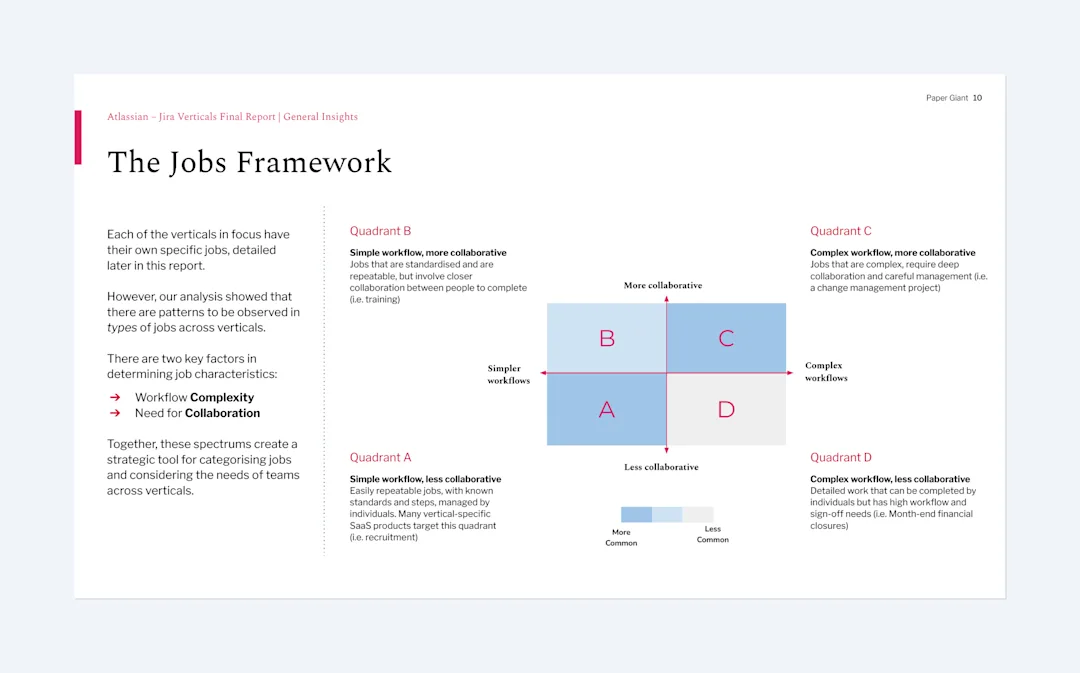
The Jobs Framework maps work across two dimensions — workflow complexity and collaboration needs — revealing where Jira's strengths naturally align
Three job types that define how business teams work
The jobs-to-be-done analysis revealed a consistent pattern across verticals. Every team has three types of work: service delivery jobs (simple, repeatable tasks handled by individuals), vertical-specific procedural jobs (more complex work with established workflows), and project management jobs (cross-functional work requiring deep collaboration). We mapped each vertical against these job types and found that Marketing and Finance have jobs most closely aligned with Jira's current capabilities. HR is well-suited but has stronger privacy and compliance needs. Sales, with its relationship-driven and less standardised work, is the least natural fit for a tool designed around structured workflows.
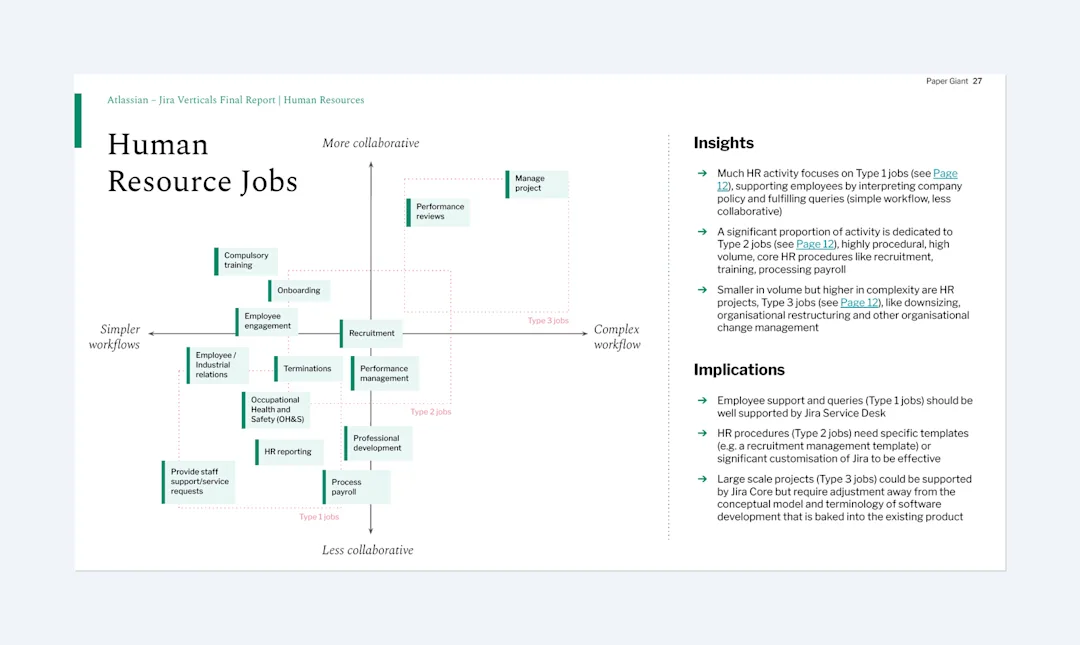
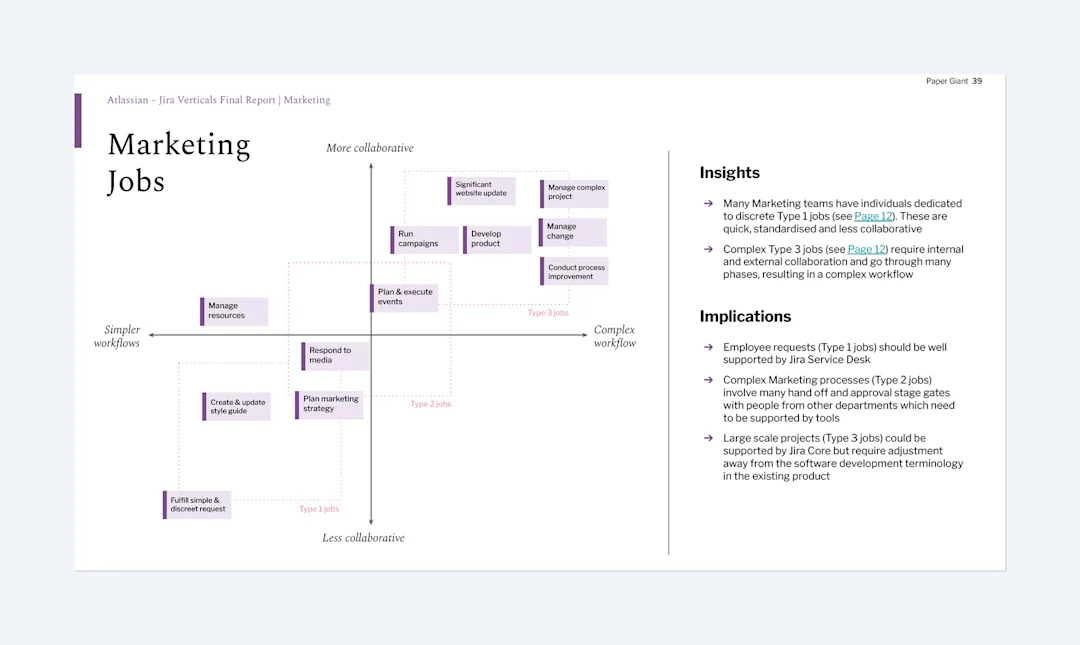
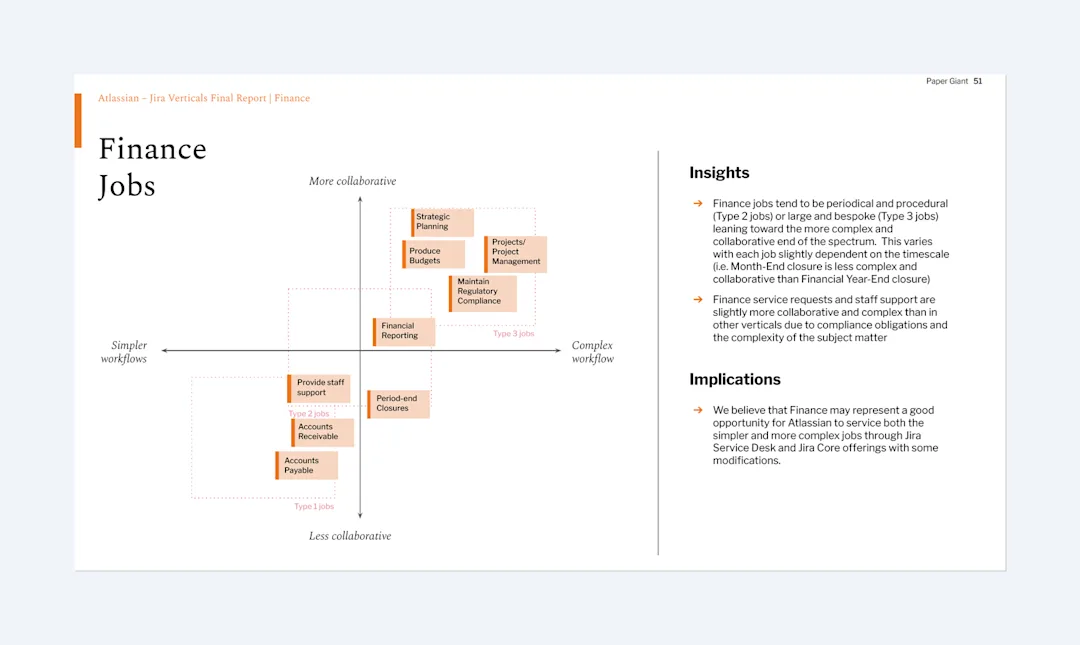
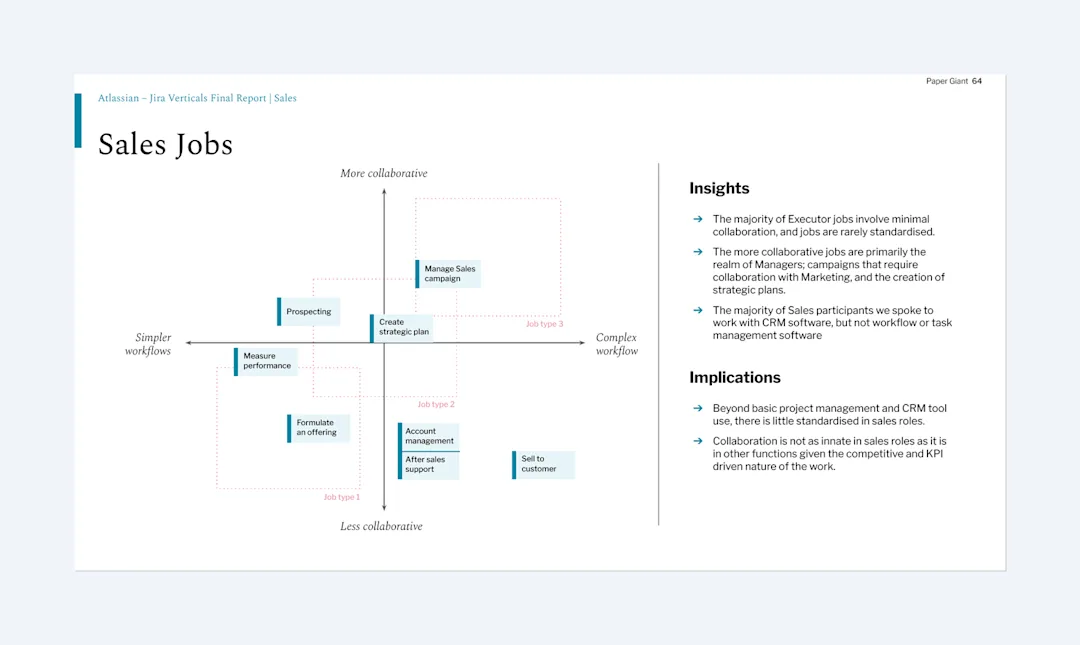
Jobs-to-be-done frameworks mapped across HR, Marketing, Finance, and Sales — each vertical revealed distinct job clusters that Jira would need to support beyond its software development roots.
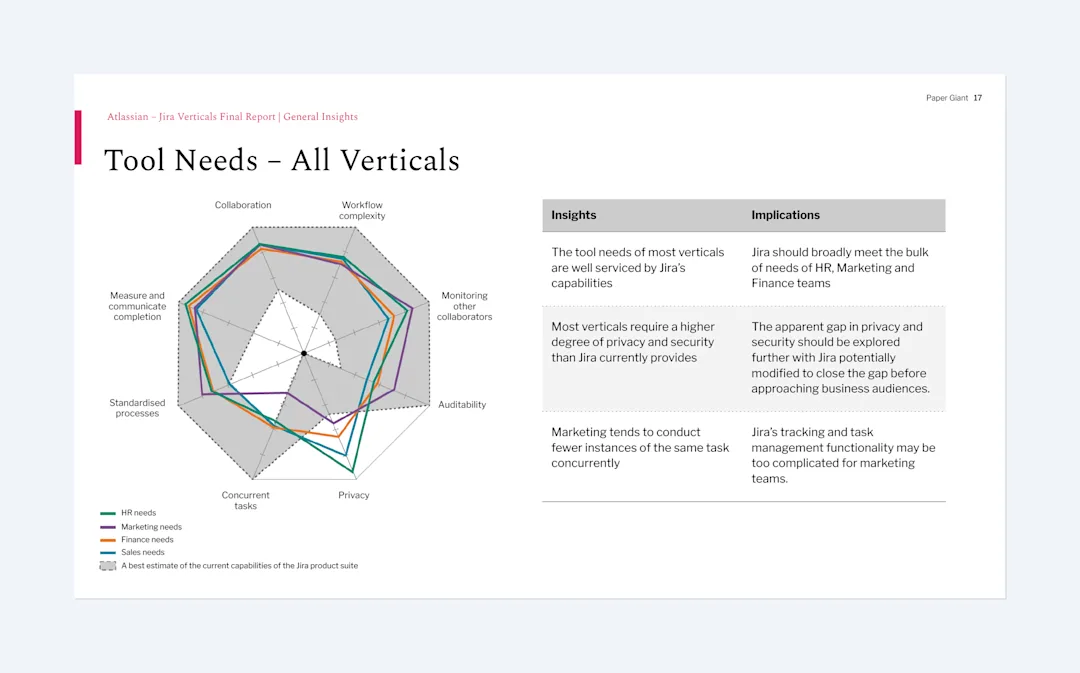
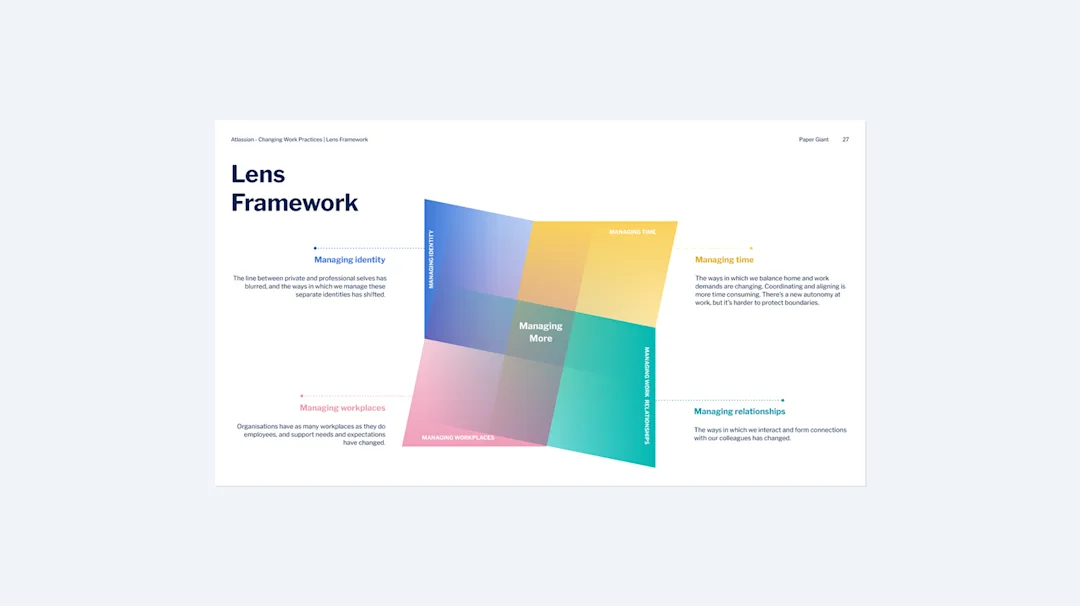
The Tool Needs Framework maps each vertical's requirements against Jira's current capabilities — revealing privacy as the biggest gap across all four verticals
The real barrier isn't features — it's language
A consistent finding across all verticals was that Jira's agile-native design creates friction for business teams. Concepts like sprints, story points, and backlog grooming don't map to the jobs that Marketing, Finance, or HR teams are trying to do. A Marketing Program Manager running a campaign doesn't think in epics and stories. A Finance analyst closing the books doesn't need velocity charts. Teams that adopted Jira without this translation developed workarounds — or abandoned the tool entirely. As one participant told us: "We don't understand the information hierarchy in Jira... there is the hierarchy of epic, story, we don't use that."
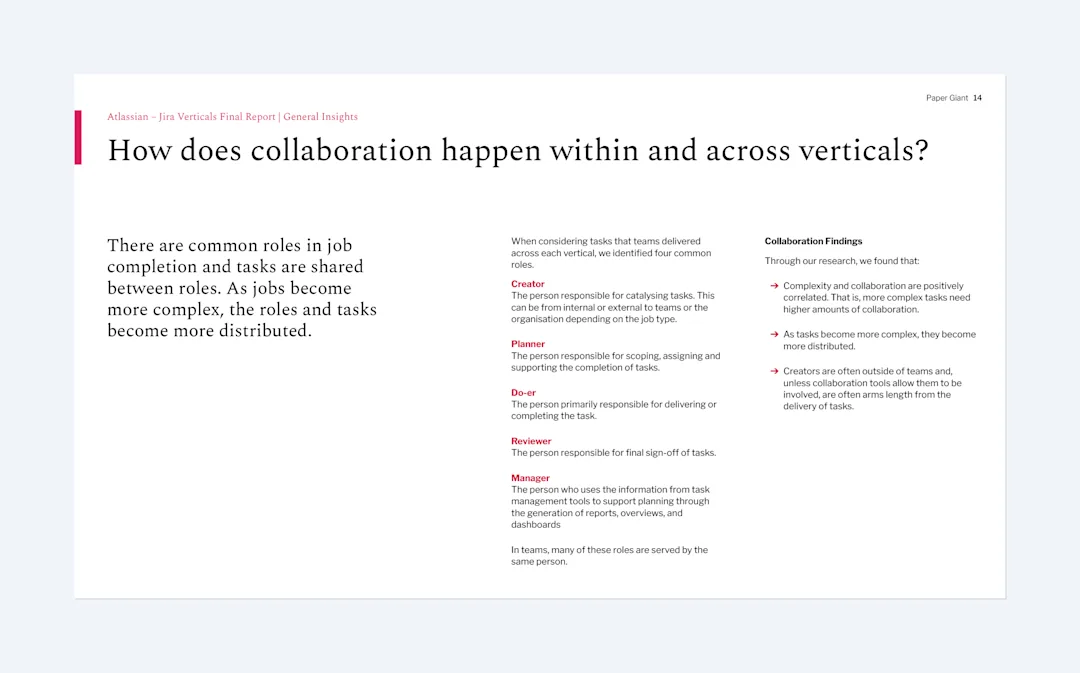
Mapping collaboration roles across verticals showed that as work becomes more complex, tasks become more distributed across creators, planners, do-ers, and reviewers
A roadmap sequenced around job complexity
We delivered a three-horizon product roadmap for Jira's expansion, sequenced around the job types we'd identified. The first horizon targets service delivery jobs — simple, repeatable work that exists across all verticals and provides the easiest onboarding path. The second introduces vertical-specific templates for procedural jobs, where Marketing and Finance showed the strongest immediate fit. The third enables cross-functional project management, which only becomes viable once multiple teams are using the tool. This sequencing builds adoption incrementally, letting teams grow into Jira through jobs they already recognise rather than confronting its full complexity from day one.