Menzies Foundation
What 57 conversations revealed about keeping young people in school
With the Menzies Foundation, Murdoch Children's Research Institute and the University of Melbourne, we spent time in two very different schools asking students, teachers and families what engagement looks like from the inside. Across 57 interviews, young people described engagement as something built through relationships and the structures around them — and showed us why students who leave school early are responding predictably to barriers the system puts in their way.
Outcomes
- 57 interviews with students, teachers and families across Katherine High School (NT) and Warakirri College (NSW)
- Nine insights showing that disengagement follows predictably from barriers in the system — evidence the Foundation can put in front of policymakers
- Four practical areas for intervention — personal connection, cultural safety and belonging, classroom practice, and infrastructure and policy — ready for cross-sector workshops
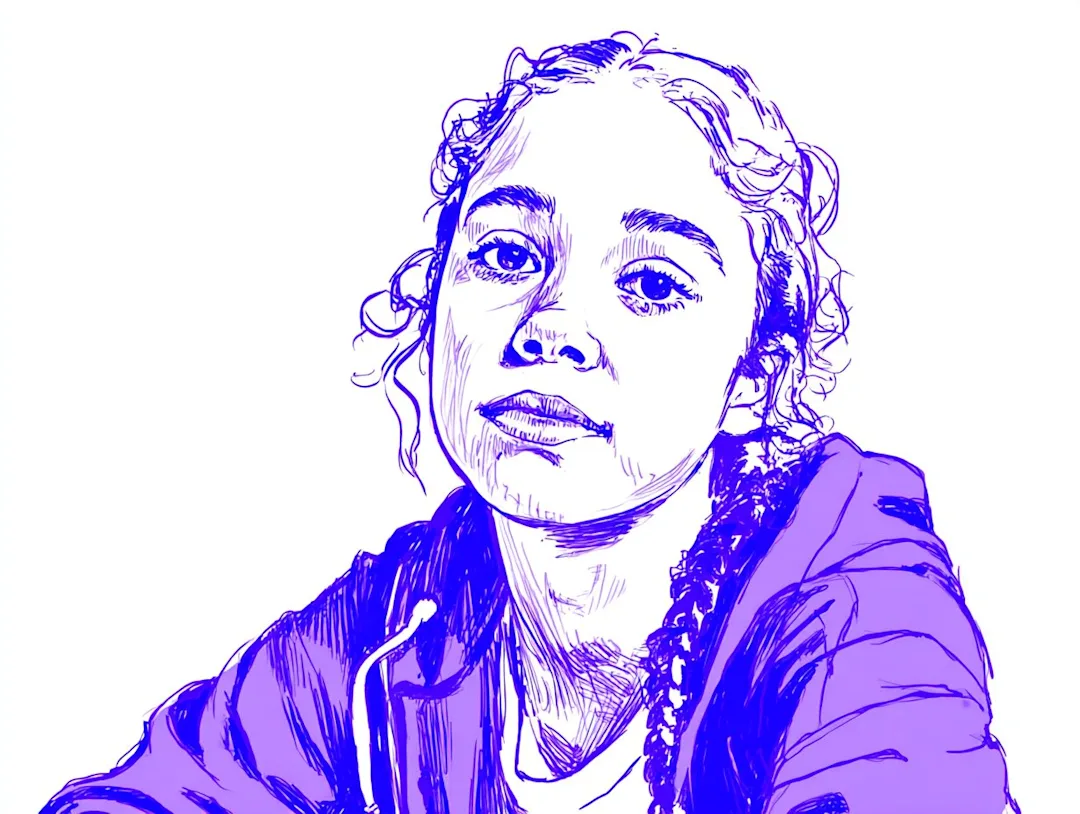
- Illustrated stories of four composite students, keeping lived experience at the centre of workshop conversations
- Workshop materials that let educators, researchers and philanthropic partners work from the same evidence base
Services
- Design research
- Strategic Design
Sectors
When attendance metrics miss what matters
One in five Australian students leaves school before Year 12, and the gap between advantaged and disadvantaged schools continues to widen. The Menzies Foundation wanted to understand what is really happening for the most disengaged students — and to build that understanding from lived experience, hearing from the people closest to the problem. Working alongside the Murdoch Children's Research Institute and the University of Melbourne, we designed research to do exactly that.
Listening in two very different schools
Our research spanned two deliberately contrasting contexts: Katherine High School in the Northern Territory, where 70% of students are Aboriginal and many travel from remote communities; and Warakirri College in NSW, a trauma-specialised alternative school for students who've exhausted mainstream options. We conducted 57 semi-structured interviews — 28 students, 20 teachers and support staff, and 12 parents and carers — and asked people to describe engagement in their own terms. Their answers sat a long way from the frameworks that drive policy.
Get the relationship right first. Get the learning conditions right next. Then you can start working on learning.
— Carolyn Blanden, Principal, Warakirri College
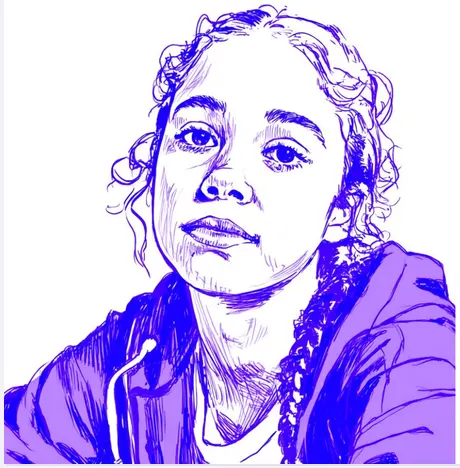



Illustrated journey personas capturing the lived experience of students and teachers navigating mainstream and alternative education systems — from isolation to belonging, compliance to connection.
The hidden labour of engagement
Much of the work that keeps students connected to school never appears in a job description. At Katherine High, an engagement officer described administering insulin daily — essential care, quietly absorbed into the school day. At Warakirri, a parent searching for alternatives told us simply, "We've run out of schools."
We also found that 'engagement' itself was deeply contested. Across 57 interviews we heard eight distinct — and often conflicting — definitions. Teachers measured attendance. Students described belonging. Parents talked about safety. Those differences shape what gets funded, what gets measured, and whose experience counts.
As one student put it: "I was always engaged. The system just couldn't see it until someone measured what actually mattered."
At my old school, I had no one. People were horrible to me. Here, people actually talk to me. I have friends. It sounds simple but it's everything.
— Student, Warakirri College
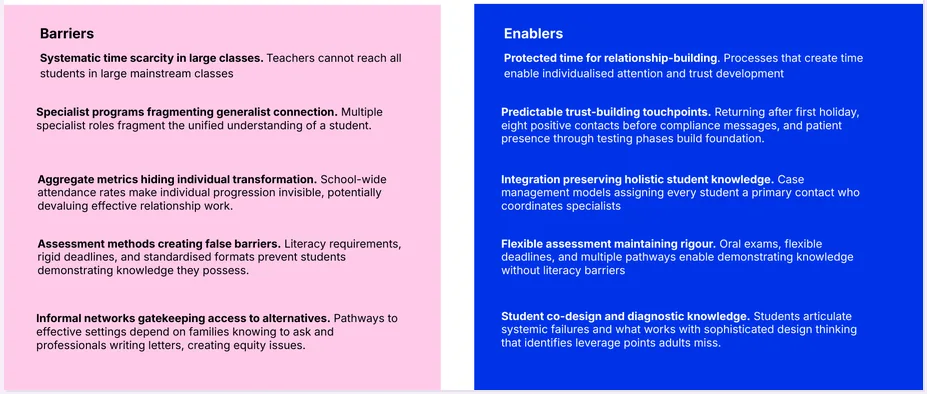
Our barriers and enablers framework mapped the systemic, relational, and individual factors that help or hinder school engagement across both research sites.
Students know what makes engagement possible
When students talked about engagement, they talked about relationships. They described precisely what builds and destroys their capacity to engage: a teacher's "I'll help you in a minute" that becomes a broken promise when the period ends without help arriving; trust that builds in predictable phases when adults stay consistent; progress from one day's attendance a week to three that counts as transformation for the student and disappears entirely in aggregate data.
We brought these findings together into four practical areas for intervention — personal connection, cultural safety and belonging, classroom practice, and infrastructure and policy. The Foundation is now using them in cross-sector workshops where student voice sits alongside professional expertise in designing what comes next.
Now I understand I'm there to build relationships that make learning possible. The kids didn't change — I did.
— David, Teacher