Department of Education, Skills and Employment
Uncovering what helps and hinders innovation inside a federal department
We partnered with the Department of Education, Skills and Employment (DESE) to understand why public sector employees struggle to innovate, even when they want to. Through deep qualitative research with 26 staff and leaders, we identified six key insights and a series of opportunity spaces that gave DESE an evidence base to act on.
Outcomes
- Deep understanding of individual, team and organisational enablers and barriers for employee innovation, grounded in 26 qualitative interviews
- Six key insights framed in the employee voice, giving DESE a human-centred evidence base that augments their APS Employee Census data
- Opportunity spaces mapped to DESE's strategic innovation pillars, providing a clear framework for action
- Practical digital whiteboard templates for running stakeholder workshops to identify and prioritise innovation initiatives
- An adaptive research approach that maintained rigour through a period of organisational restructure and a federal election
Services
- Design research
- Customer research
- Strategic Design
Sectors
A department wanting to do things differently
The Department of Education, Skills and Employment works to ensure Australians can access the wellbeing and economic benefits that quality education, skills and employment provide. Their internal innovation team had been working to encourage new ways of thinking and doing across the organisation. But results from the annual Australian Public Service (APS) Employee Census told a different story — barriers still existed for staff who wanted to engage with innovation. DESE came to us to find out why. They wanted to move beyond survey data and hear directly from the people experiencing these barriers day to day.
Listening to the people closest to the work
We designed and conducted 21 semi-structured interviews with staff who had tried new or different ways of doing things, alongside 5 leadership interviews to understand the view from above. The interviews explored motivations for engaging with innovation, individual and organisational enablers and barriers, and perceptions of DESE's innovation language and culture. Using affinity diagramming and grounded theory analysis, we synthesised the qualitative data into themes that captured both what helps people innovate and what holds them back. This work was delivered during a period of significant change — an organisational restructure was underway and a federal election campaign was running — so we adapted our approach to stay aligned with the shifting context.
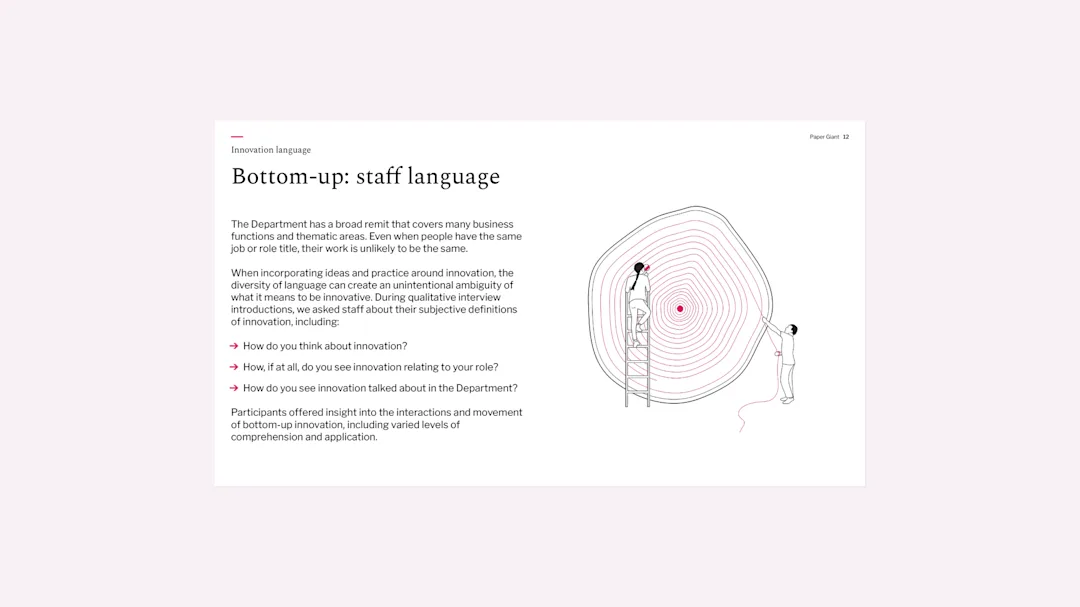
How DESE employees think about and define innovation from the bottom up — exploring the diversity of language and meaning across roles and divisions.
The innovation paradox inside government
What emerged was a picture of genuine desire to innovate sitting alongside systemic barriers that made it difficult. Staff told us innovation means different things to different people — leadership tends to think in terms of large-scale transformation, while frontline staff see innovation in the everyday improvements they make to their work. This disconnect creates confusion about what counts and who gets to do it. We heard about time pressures that push people toward the tried and true, environments where speaking up isn't always welcomed, and a risk-averse culture where mistakes are long remembered. But we also found enablers — supportive supervisors, informal innovation champions, and pockets of teams where experimentation was genuinely encouraged.
I'm not going to attempt anything big and innovative, unless I know that people feel safe in what they can say and do.
— DESE staff member
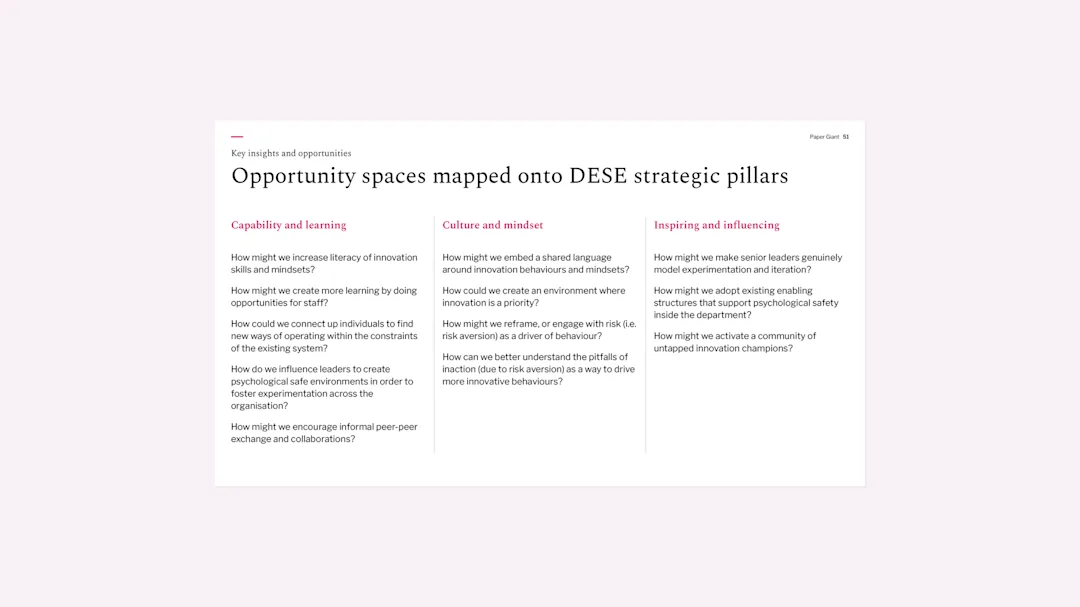
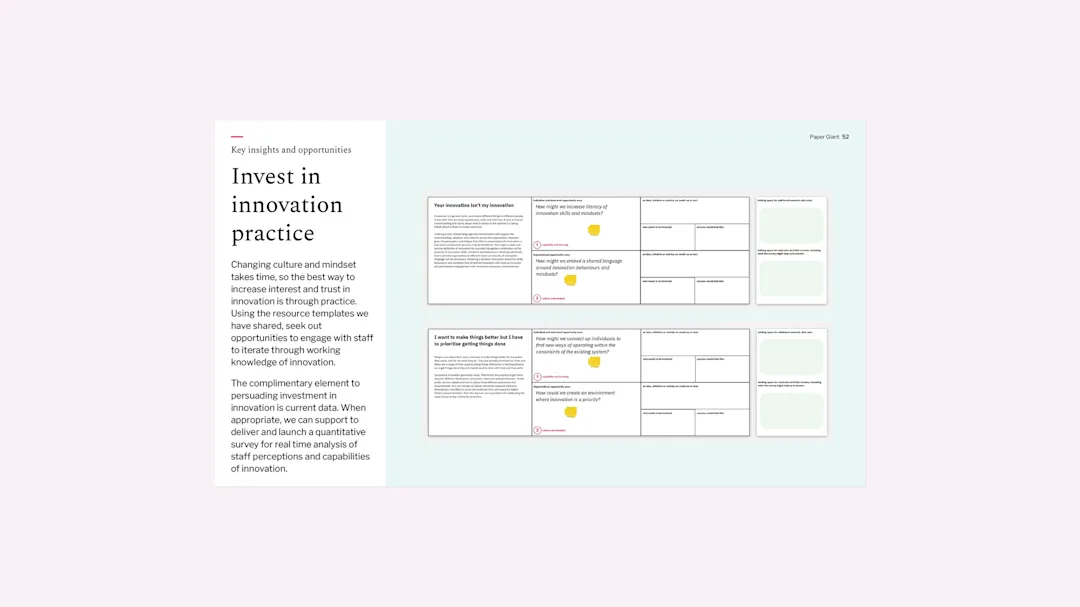
Opportunity spaces mapped to DESE's strategic innovation pillars, alongside digital whiteboard templates designed for ongoing stakeholder workshops.
Opportunity spaces mapped to DESE's strategic innovation pillars, alongside digital whiteboard templates designed for ongoing stakeholder workshops.
From insights to action
We distilled our findings into six key insights, each written in the first person to centre the employee experience — from "Your innovation isn't my innovation" to "I've got knowledge, but nobody to share it with." These insights were mapped against DESE's existing strategic innovation pillars — capability and learning, culture and mindset, and inspiring and influencing — creating a series of opportunity spaces the team could act on. To make the research practically useful beyond the report, we developed a set of digital whiteboard templates that give the innovation team a tangible way to engage decision makers in workshops, identify actions, and build on the evidence base we'd created together.