Envato
Helping Envato define the future of work for 700 people across three continents
When COVID-19 sent Envato's entire workforce home, the company faced a question bigger than "when do we go back?" We partnered with Envato to research how distributed work was really affecting their people — surveying 525 employees and interviewing 24 more across multiple geographies — and turn those findings into a strategic framework for building location-agnostic employee experiences.
Outcomes
- Strategic shift framework moving Envato from uneven, location-dependent experiences to location-agnostic employee experiences
- Mixed-methods research program reaching 525 survey respondents and 24 interviewees across multiple geographies
- Four focus areas (Culture, Ways of Working, Infrastructure, Capability) with paired insights and opportunity recommendations
- Evidence base revealing the four conditional values that drive employee preferences — giving leadership a framework for decision-making beyond opinion
- Persona-level considerations enabling teams to design responses that account for diverse needs rather than defaulting to one-size-fits-all policies
The office was the default, but the world had moved on
Envato had always allowed remote work, but the office remained the dominant template — the place where culture happened, relationships formed, and careers progressed. When the pandemic forced everyone home, the cracks became visible. Fragmented work-from-home policies created uneven experiences depending on where you lived and what your role looked like. Half the workforce felt the company wasn't prepared to support distributed work.
Envato didn't want to simply choose between "back to the office" and "remote forever." They wanted to understand what their people actually needed, and design a future of work that responded to the reality of how 700 employees across Australia, the US, and beyond were experiencing their working lives.
Over 500 experiences, one clear picture
We designed a mixed-methods research program that reached across Envato's entire organisation. A survey of 525 employees captured the quantitative picture — preferences, satisfaction scores, effectiveness ratings, and the conditional factors that shaped how people felt about remote work. Twenty-four in-depth interviews gave us the stories behind the numbers: how people were actually navigating the blur between work and home, what they were gaining and losing, and what they needed from their employer.
The research spanned multiple geographies and every level of the organisation, from team members to senior leadership. What we heard wasn't a simple binary. It was a complex picture of diverse needs, conditional preferences, and a workforce that wanted agency over how they worked — not a one-size-fits-all policy handed down from above.
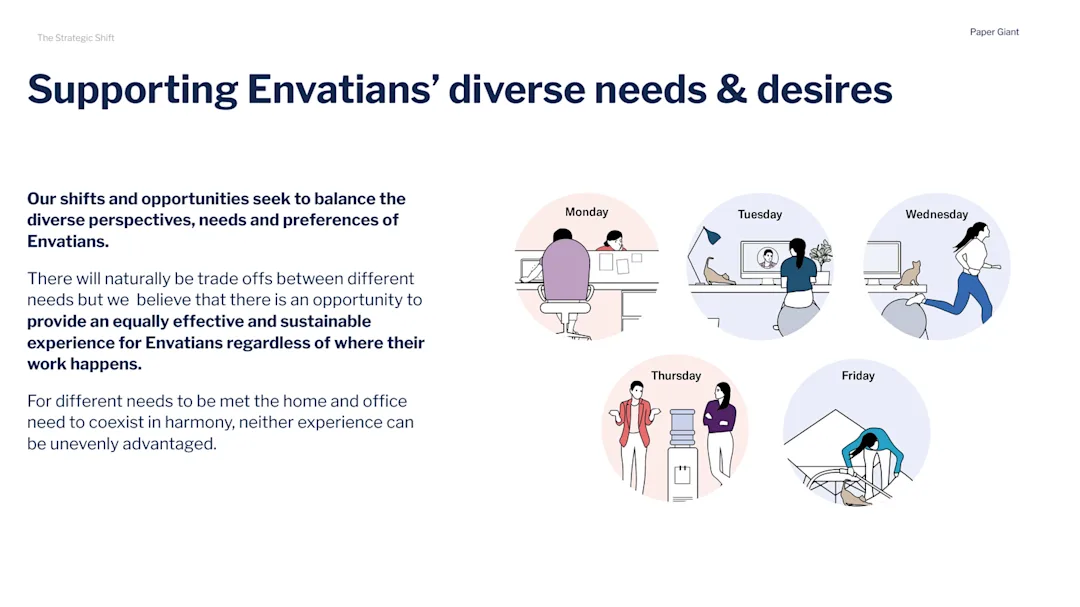
Our research revealed that Envatians' needs varied dramatically — not just between people, but across different days and contexts within the same person's week
A strategic shift, not a policy change
The research pointed to something bigger than a remote work policy. Envato needed to move from uneven experiences — where your location determined your access to culture, opportunity, and effectiveness — to location-agnostic experiences where people could do their best work regardless of where it happened.
We found that 56% of Envatians preferred some form of hybrid work, while 40% wanted to work entirely from home. But preferences alone didn't tell the full story. They were conditional on four things being true: that work-life balance was protected, that it was reasonably easy to be effective, that social connection and workspace ambience were maintained, and that professional growth wasn't tied to physical presence. When any of those conditions failed, preferences shifted — and resentment followed.
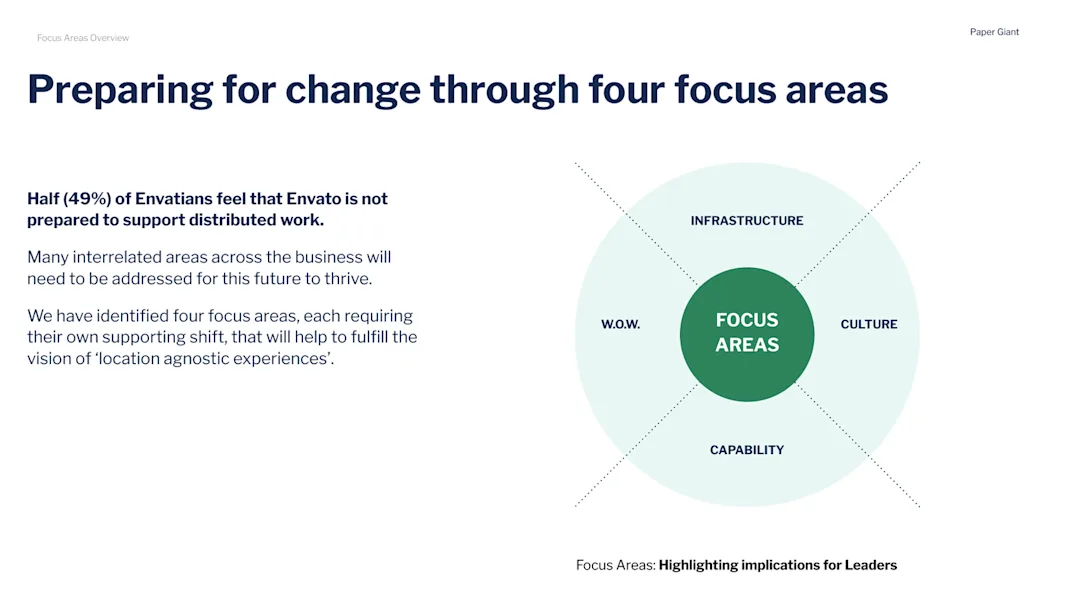
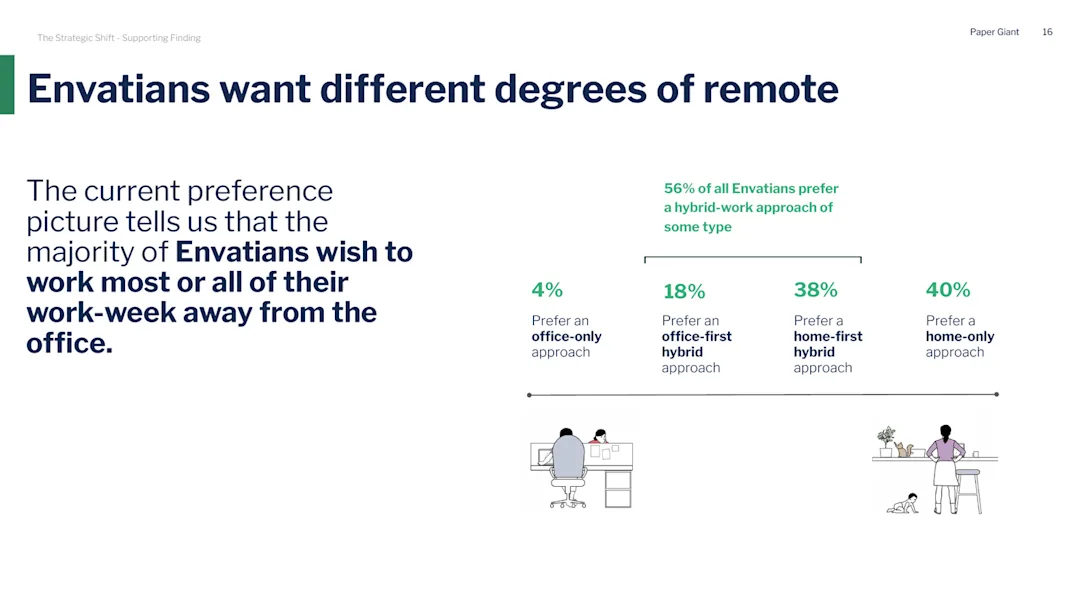
Preference data revealed the majority of Envatians wanted to work mostly or entirely from home. Four interconnected focus areas needed to shift for location-agnostic experiences to work.
Preference data revealed the majority of Envatians wanted to work mostly or entirely from home. Four interconnected focus areas needed to shift for location-agnostic experiences to work.
Four focus areas to make it real
We identified four interconnected focus areas, each with its own supporting shift. Culture needed to move from multiple location-dependent cultures to one purpose-led culture with local applications. Ways of working needed to shift from office-first defaults to outcomes-led, fit-for-purpose practices. Infrastructure needed to evolve from divided access to boundary-less places of work. And capability needed to move from traditional workplace skills to a new set that equipped people for distributed collaboration.
For each area, we developed paired insights and opportunities — grounded in what the data showed, not what conventional wisdom assumed. We found that 36% of hybrid workers would change their preference just to match their team, driven by a desire not to be in the minority. We found that 34% were struggling with home responsibilities in ways that eroded their work-life balance. And we found that leaders, who had the highest desire to return to the office, needed targeted support to manage the added complexity of distributed teams.
Research that became Envato's north star
The strategic shift framework gave Envato's leadership a shared language for making decisions about the future of work — not as a single policy announcement, but as an ongoing design challenge. The four focus areas became the structure for a next phase of work where Envato could reimagine models, strategies, and initiatives to enable location-agnostic experiences.
The research didn't prescribe answers. It gave Envato the evidence and frameworks to design their own — grounded in what over 500 of their people actually said they needed, not what the loudest voices in the return-to-office debate were arguing for.