headspace Schools & Communities
Crafting a strategic narrative for Australia's youth mental health foundation
We partnered with headspace Schools & Communities to build a strategic narrative that clearly communicates who they are, why they exist, and how they work — to internal teams, government partners, schools, and the communities they serve. Through broad co-creation with staff, stakeholders, and community members, we developed a narrative that the whole organisation could own and use.
Outcomes
- Strategic narrative document articulating headspace Schools & Communities' purpose, vision, audiences, approach, and focus areas
- Branded, modular assets designed for use across different stakeholder contexts — from internal alignment to government engagement
- Ecosystem framework mapping every stakeholder group in relation to the young person at the centre
- Four focus areas providing a clear structure for communicating the breadth of the division's work
- Shared ownership through broad co-creation — staff, partners, and community members contributed to and invested in the final narrative
Sectors
A critical service without a shared story
headspace Schools & Communities provides wraparound support for young people across the mental health continuum — from building mental health literacy in schools through to response and recovery after critical incidents. Their work spans communities across Australia, involving educators, families, local workforces, universities, and government at every level.
But the division didn't have a clear, shared way of explaining what they do and why it matters. Different teams described the work differently. External stakeholders received inconsistent messages. Without a unifying narrative, it was harder to build partnerships, align internal teams, and communicate scope to the government bodies that fund the work.
Five workshops, many voices, one story
We ran five co-creation workshops with staff, external stakeholders, partners, and community members — deliberately engaging across the ecosystem so the narrative would reflect how the division is experienced, not just how it describes itself. Weekly work-in-progress sessions with the core team surfaced tensions early: where stakeholder groups saw things differently, where language choices carried unintended meaning, where the scope needed deliberate boundaries.
Leadership gate-checks at key moments ensured the narrative aligned with headspace's broader organisational strategy. And we developed a set of working principles — how the narrative's elements should connect, what the key messages needed to be, what language to avoid — that guided every iteration from first draft through to final design.
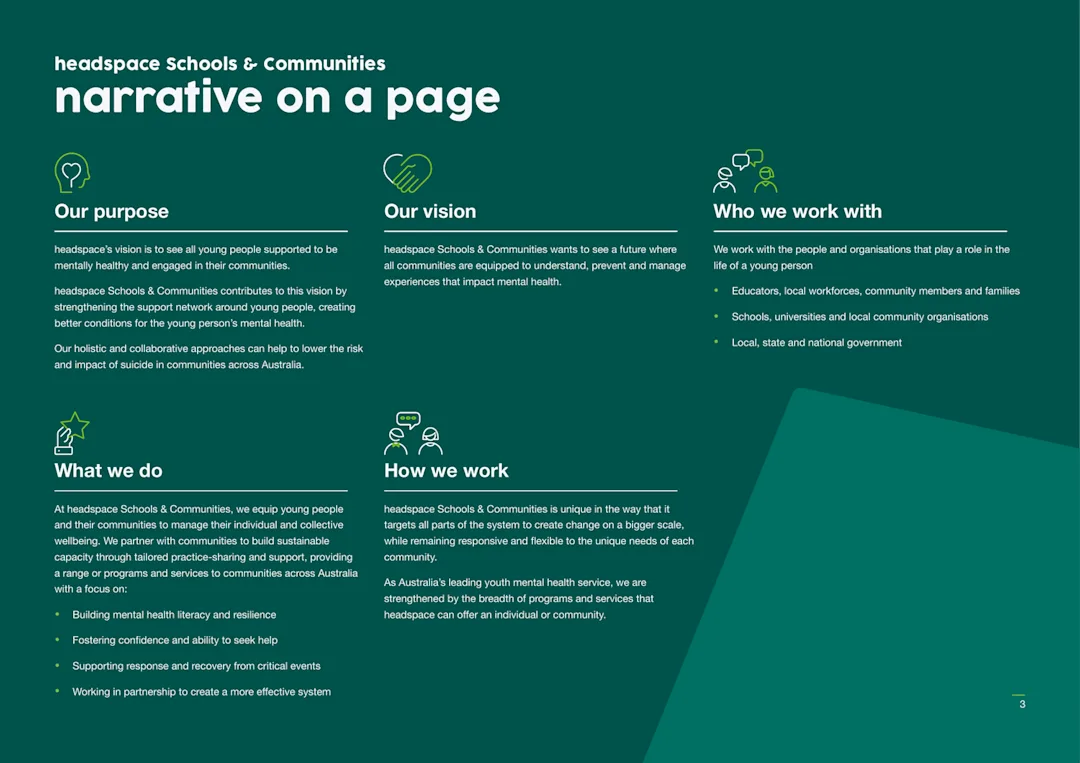
The "narrative on a page" — a single view of headspace Schools & Communities' purpose, vision, audiences, approach, and four focus areas, designed for both internal alignment and external communication
A narrative built around the young person
The strategic narrative centres on a clear purpose: headspace Schools & Communities exists because holistic, collaborative approaches can help lower the risk and impact of suicide in communities across Australia. The vision builds from there — a future where all communities are equipped to understand, prevent, and manage experiences that impact mental health.
Rather than describing the division through its programs, we structured the narrative around the system that wraps around the young person. The "who we work with" framework maps every stakeholder — from schools and families through to local government and community organisations — in relation to their role in a young person's life. And the four focus areas (building literacy, fostering help-seeking, supporting response and recovery, partnering for system change) give teams a clear way to explain what they do without listing every program.
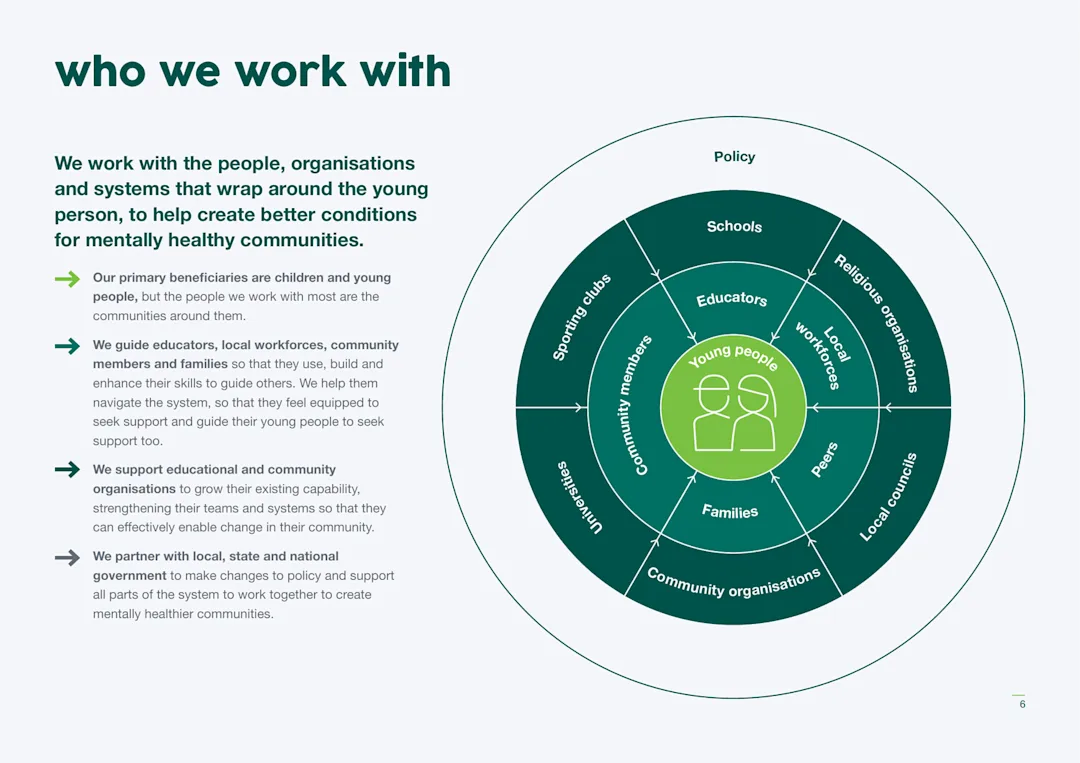
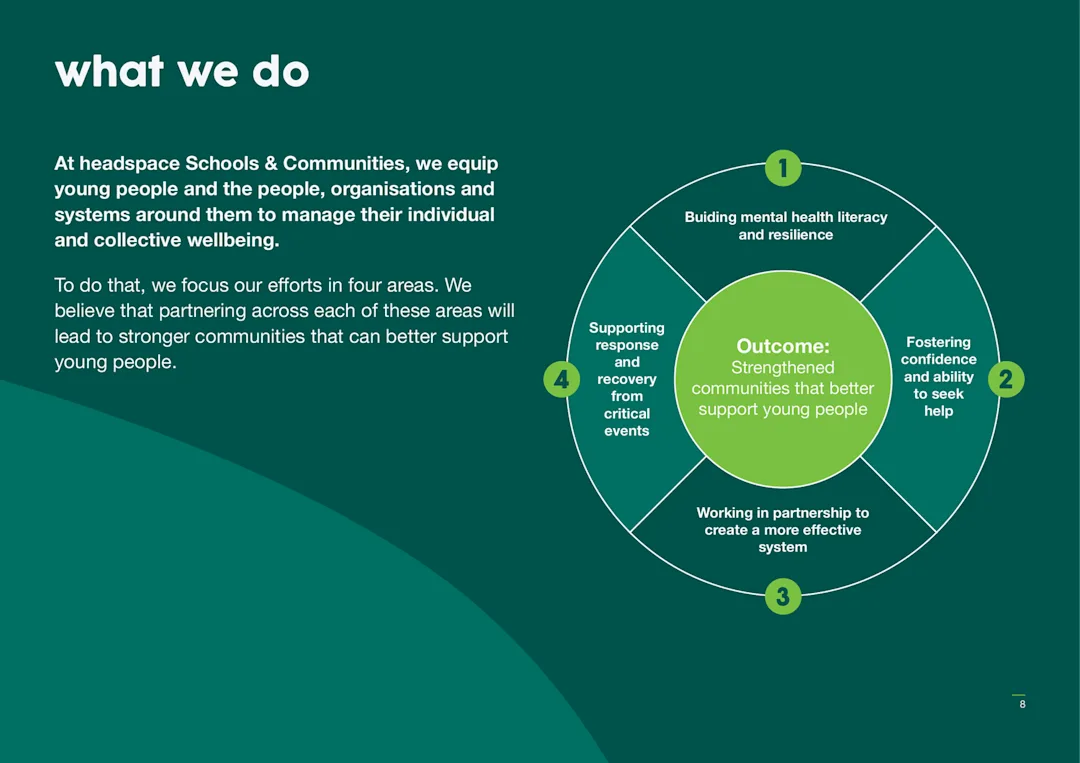
The ecosystem model centres the young person, mapping every stakeholder group by their role in supporting mental health. Four focus areas give teams a clear framework for explaining the breadth of the division's work.
The ecosystem model centres the young person, mapping every stakeholder group by their role in supporting mental health. Four focus areas give teams a clear framework for explaining the breadth of the division's work.
A document designed to be used, not shelved
The final narrative was created through many voices, but its message is clear. We designed a branded document with modular assets — purpose statements, vision language, ecosystem diagrams, and focus area descriptions — that the team can pull apart and reassemble for different audiences and contexts. A school principal needs different framing than a state government funder, but both should hear a consistent story.
The broad consultation process had an impact beyond the deliverable. By involving staff, partners, and community members in shaping the narrative, we built shared ownership across the organisation. People don't just understand the story — they helped write it, and they're equipped to bring it to life in their own contexts.