Beyond Blue
Centering community voice in Beyond Blue's strategic direction
We partnered with Beyond Blue and 18 people with lived experience of mental health challenges to validate and refine the organisation's 2023+ strategy. Through co-design workshops, we ensured that the voices and needs of the community shaped Beyond Blue's strategic goals, language, and future direction.
Outcomes
- Validated Beyond Blue's 2023+ strategic direction and theory of change with 18 community members across two participant groups
- Revised three strategic goals across individual, community, and society pillars based on direct community feedback
- Developed four guiding principles to steer future strategic writing and ensure it resonates with lived experience
- Created a "words to watch out for" framework to help Beyond Blue communicate in language the community connects with
- Produced a comprehensive research report centring community voices through verbatim quotes and detailed observations
Services
- Strategic Design
- Co-design
- Design research
Sectors
Bringing strategy back to community
As Beyond Blue shaped their strategy for 2023 and beyond, they wanted to understand how the mental health landscape had shifted and what this meant for their role in the community. The organisation had conducted extensive internal research and developed strategic goals grounded in academic frameworks — but they needed to know whether those goals genuinely resonated with the people they serve. Beyond Blue came to us to help validate these insights directly with community members, testing whether the assumptions underpinning their theory of change reflected real lived experience.
Creating space for honest conversation
We designed two rounds of workshops with two distinct participant groups: Blue Voices members — people who actively share their lived experience to guide Beyond Blue's work — and broader community participants with personal or carer experience of mental health challenges. The first workshop explored how Beyond Blue's strategic goals aligned with the moments that matter in people's mental health journeys. The second went deeper into language and tone, testing content concepts and inviting community members to evaluate and iterate the wording of strategic messages. Our semi-structured approach created a safe environment where participants could share candid, unfiltered responses.
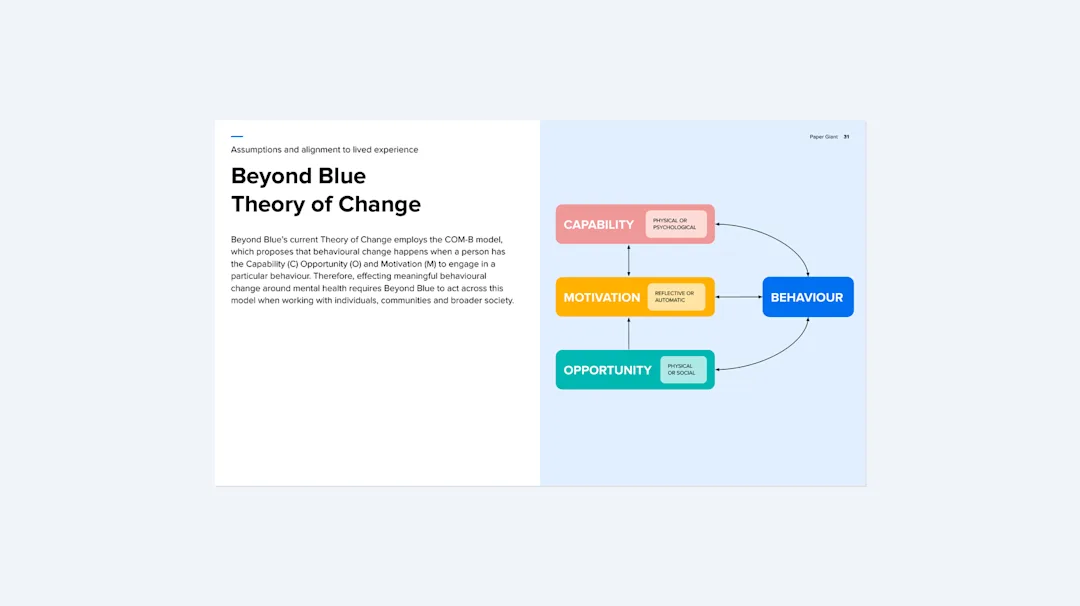
Beyond Blue's Theory of Change employs the COM-B model of behavioural change — our workshops validated this framework against community members' lived experience.
What community told us
Community members confirmed that Beyond Blue's strategic goals were on the right track — the moments and needs they shared aligned with the three core goals around supporting individuals, building community, and shaping society. But the language needed work. Words like "prevent" carried connotations of fault or failure. Terms like "help" and "educate" felt patronising to people in vulnerable moments. Clinical jargon alienated readers and made them doubt whether they were the intended audience. Community members wanted plain, warm language that acknowledged the complexity of their experience without oversimplifying it. They wanted to feel that Beyond Blue was speaking with them, not at them.
People used to say, 'go into the system and it'll look after you', but if you're not in it you don't know what that is.
— Blue Voices Community Participant
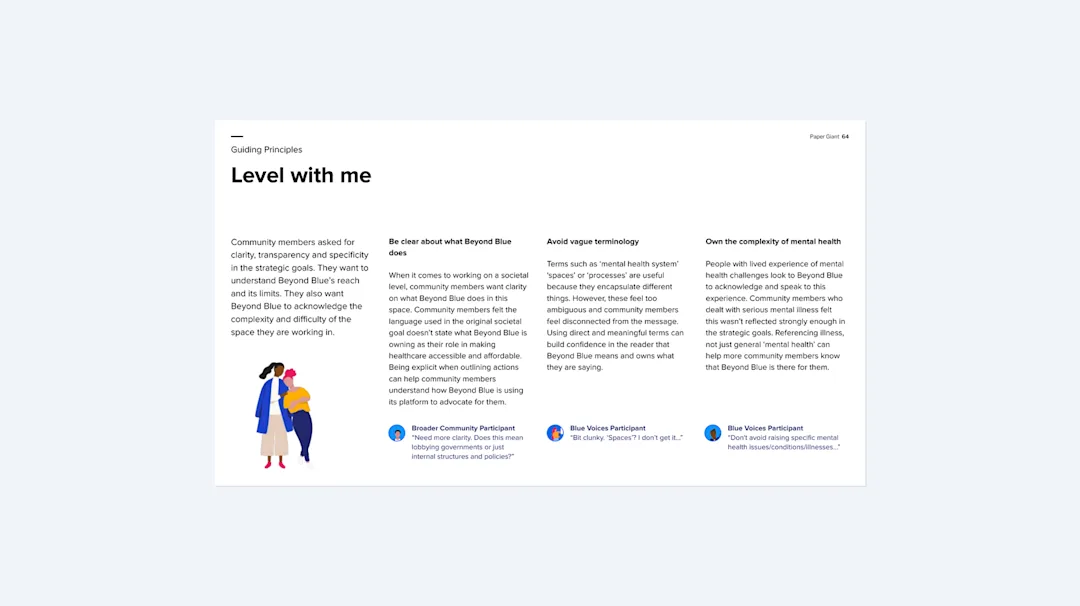
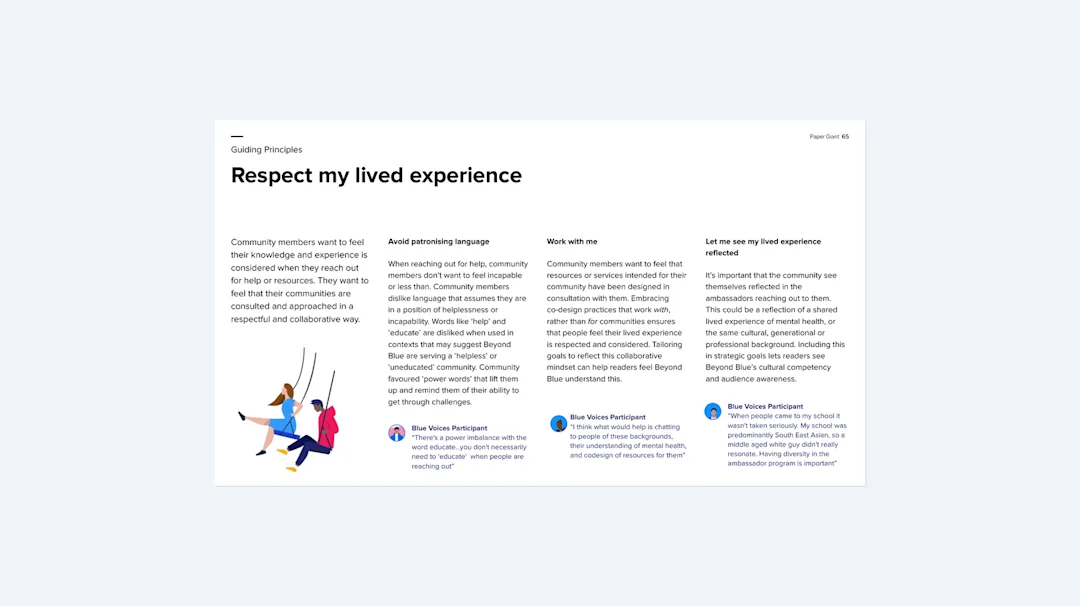
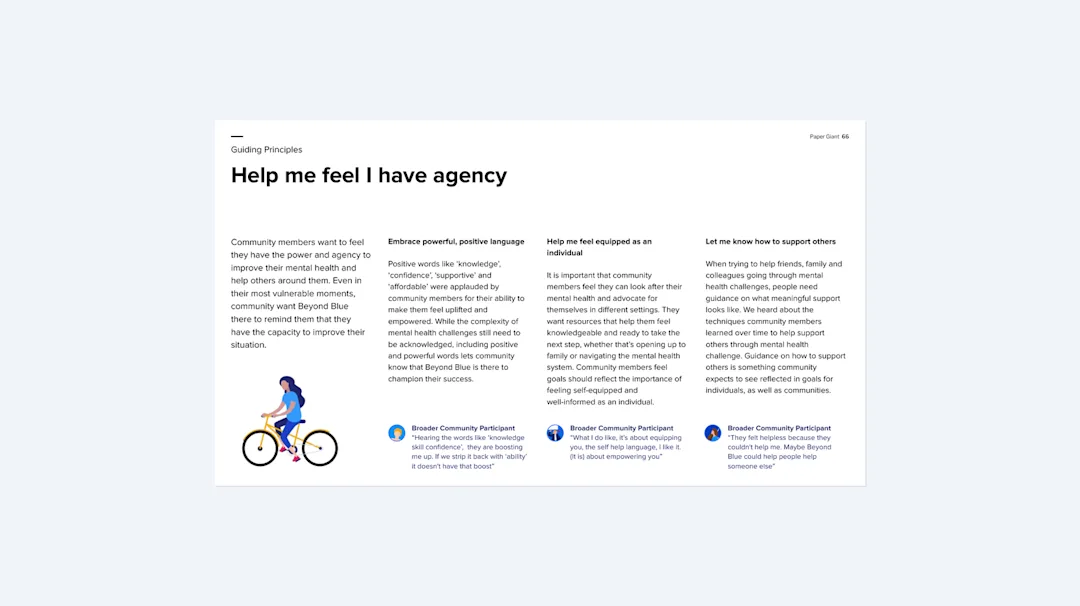
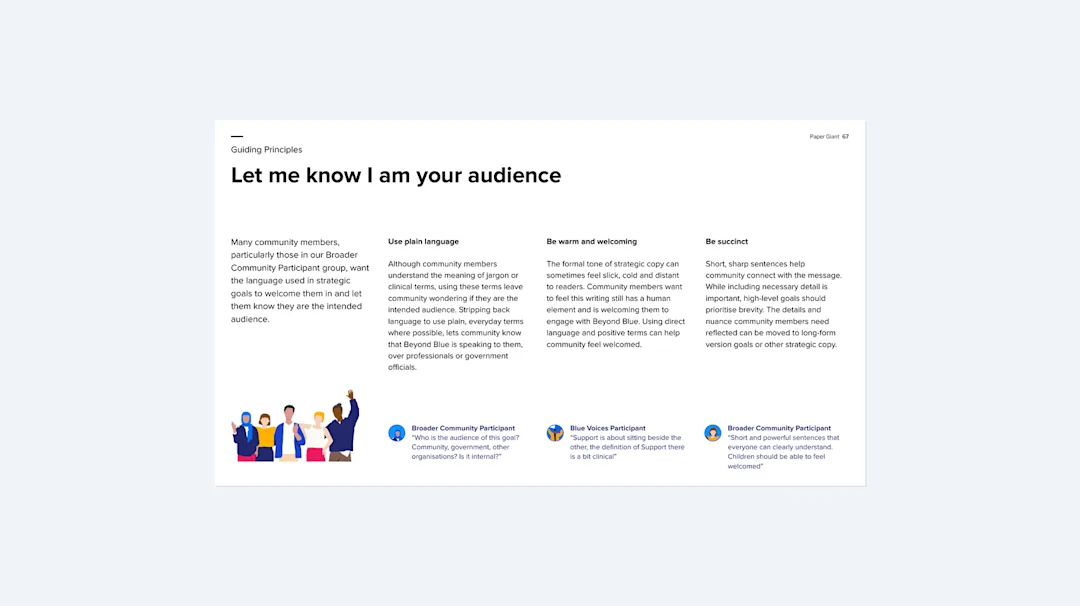
Four guiding principles drawn from community workshops — each translates lived experience into actionable direction for Beyond Blue's strategic writing and communications.
Reshaping strategy through lived experience
Working directly with community, we revised all three strategic goals to better reflect participants' feedback — replacing vague terminology with direct, meaningful language and swapping clinical words for plain, empowering alternatives. We developed four guiding principles that translate community insights into ongoing direction for strategic writing: level with me, respect my lived experience, help me feel I have agency, and let me know I am your audience. We also created a "words to watch out for" framework identifying language that community found overused, jargon-heavy, patronising, or vague — giving Beyond Blue a practical tool for any future strategic communication.