Transport Accident Commission
Transforming internal communications from reactive noise into strategic capability at TAC
We partnered with the Transport Accident Commission to transform their internal communications function from reactive and fragmented into a strategic capability that enables organisational change. Through 70+ stakeholder consultations and a coaching-led implementation model, we helped TAC's IC team shift from managing information overload to architecting connections that support their mission of safer roads and better recovery for Victorians.

Outcomes
- Strategic elevation of the IC function from reactive service provider to trusted strategic advisor with executive endorsement
- Role-based communication framework replacing traditional org-chart segmentation, enabling targeted messaging across five stakeholder roles
- Digital request management system making IC work visible, measurable, and strategically prioritised
- 90-day planning rhythm embedded and run independently by the IC team
- Coaching model that transferred lasting capability — the team now questions more, reflects intentionally, and designs for user needs
- Communications playbook prototype tested with real users and built for ongoing team ownership
The Jury recognises Paper Giant's rigorous design-led approach to transforming internal communications at the Transport Accident Commission, noting the successful reframing of traditional IC models through human-centred research with over 70 stakeholders.
— Jury, 2026 Australian Good Design Awards
A workforce overwhelmed but under-informed
TAC exists to prevent road trauma and support Victorians when accidents happen. They were embarking on significant strategic transformation — but their internal communications couldn't keep pace. Employees reported being overwhelmed by emails yet unable to locate critical information. Staff spent more than 30 minutes searching for basic updates in outdated systems. Different divisions received inconsistent messages with no single source of truth.
The IC team was trapped in a cycle of last-minute requests that left no space for strategic work. As Hannah Ivanovskis, Internal Communications Manager, put it: "We were so busy reacting and delivering that our own strategy could never be prioritised." This wasn't just an operational problem — without effective internal communications, TAC's transformation initiatives risked failure.
Getting under the hood with 70+ stakeholders
We conducted research with over 70 stakeholders across every division — from frontline claims officers with tight 30-minute windows between client interactions to executive leadership shaping strategic direction. We mapped how information actually flows (and fails to flow) through the organisation using deep-dive interviews, communication ecosystem mapping, and co-design workshops with the IC team and cross-functional stakeholders.
What emerged was a fundamental insight: the same person plays different communication roles in different contexts. Rather than segmenting by org chart, we developed a role-based framework — Strategic Owners, Information Drivers, Information Sharers, Action Takers, Information Seekers — that acknowledged this fluidity and enabled more targeted, effective communication.
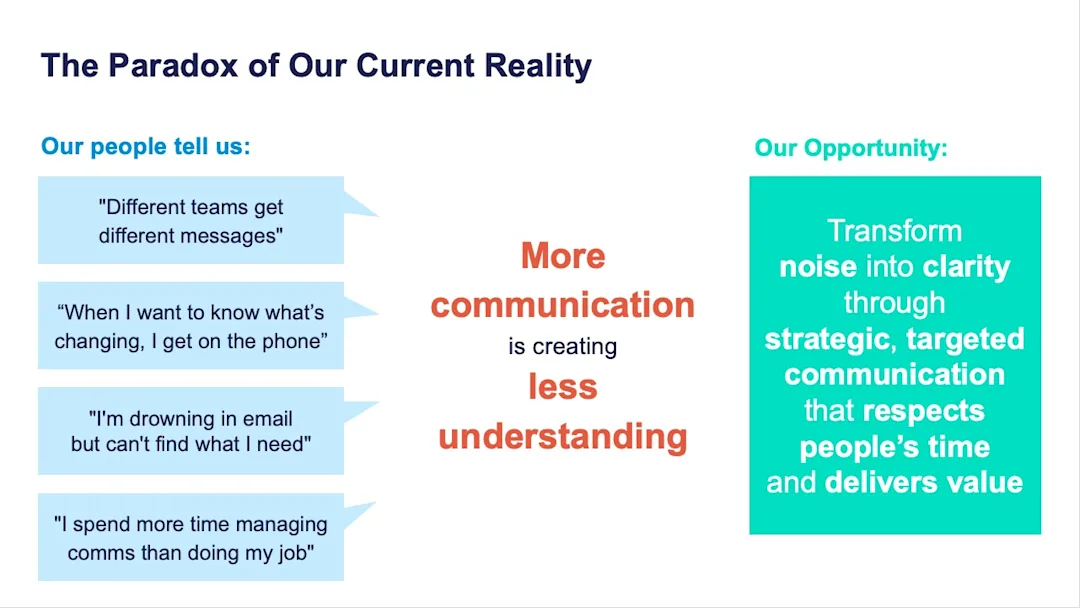
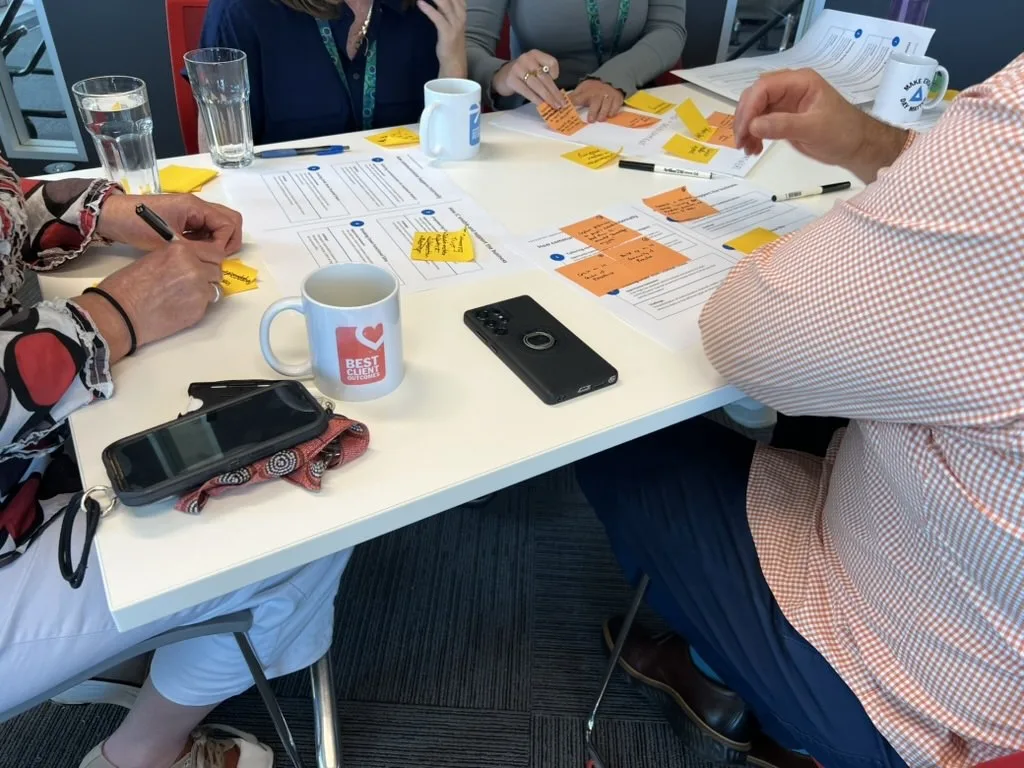
Research revealed the communications paradox, while co-design workshops mapped how information flows through the organisation
Research revealed the communications paradox, while co-design workshops mapped how information flows through the organisation
We worked with Paper Giant to connect them to over 70 stakeholders at all levels across the organisation. Some of the consultation was in workshops that we were a part of, and some of it was Paper Giant one-on-one with key stakeholders and bringing findings back to us. This was a great combination as they were able to spend time that we didn't have getting under the hood.
— Hannah Ivanovskis, Internal Communications Manager, TAC
Three shifts that changed how TAC communicates
The strategy we developed introduced three fundamental shifts. First, from control to coordination — repositioning IC as air traffic control rather than gatekeepers. Second, from push to pull — making information available when people need it, not just when it's sent. Third, from reactive to proactive — aligning communications planning with TAC's 90-day strategic cycles.
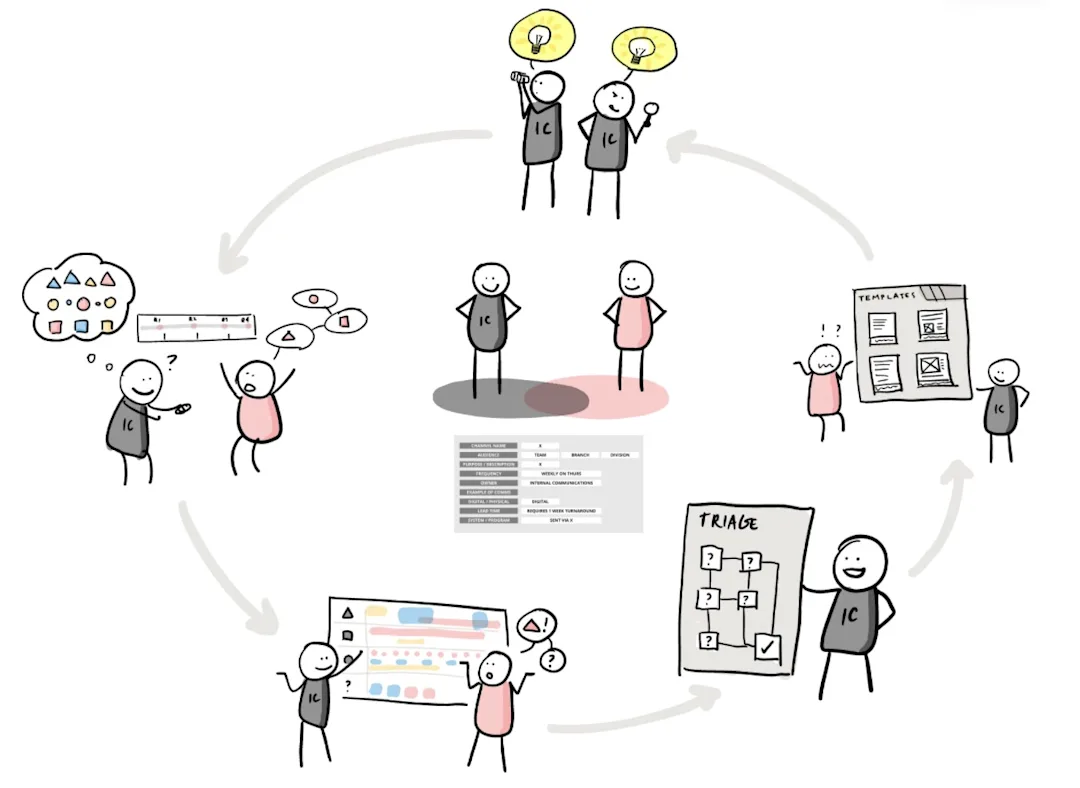
We designed a five-stage service model that transformed IC from reactive order-taking to proactive strategic partnership. By embedding IC professionals directly into planning cycles, the team could anticipate communication needs rather than scramble to meet last-minute requests.
The service model we designed with TAC — positioning the IC team as strategic partners who plan, align, communicate, capture, and deliver across the organisation
Building capability through coaching, not consulting
Rather than delivering a strategy document and walking away, we designed an implementation model that transferred capability through a masterclass-style coaching approach. Three parallel workstreams ran simultaneously: a leader communications program, playbook implementation converting strategy into accessible tools, and a digital request management system to track work and demonstrate value.
We built a prototype playbook to test how strategic communications principles could work in TAC's daily reality — quick answers in plain language, not lengthy guidelines. Structured weekly reflection sessions helped the team convert experience into transferable knowledge. The process transformed not just the tools but the team's confidence to design for user needs rather than assumed requirements.
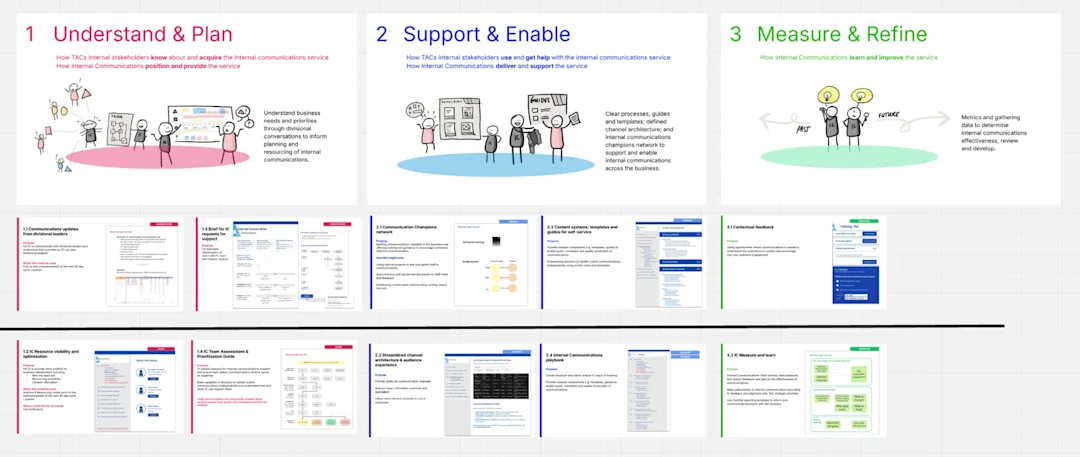
The three-phase strategy framework: Understand & Plan, Support & Enable, Measure & Refine — each with detailed playbook pages the IC team now owns and runs independently
A team that questions more and plans with intention
The impact goes beyond new tools and processes. TAC's IC team now operates with a 90-day planning rhythm they run independently. A digital request system makes their work visible and measurable. Leadership views the IC function as a trusted strategic advisor — brought into conversations earlier to shape messaging rather than publish pre-ordained content.
The executive leadership team has given the IC team a clear remit to constructively manage requests and funnel them strategically. As Hannah describes it: "We are seen as strategic as well as ideas-driven, moving away from publishing pre-ordained content and being brought into conversations earlier to shape the what, where and how of messaging."
Before, we were drowning in requests and competing priorities, knowing the messages were diluted. Now we have a strategic voice, licence to operate, and our voices are trusted in the rooms that matter.
— Hannah Ivanovskis, Internal Communications Manager, TAC