Department of Education and Training
Uncovering how schools turn professional practice policies into real teaching improvement
We partnered with the Department of Education and Training's Professional Practice and Leadership Division to understand how Victorian secondary schools were implementing three key quality teaching initiatives. Our research across six schools revealed five opportunity areas to strengthen support for schools navigating significant workforce and practice changes.

Outcomes
- Identified five opportunity areas for DET to strengthen implementation support across Victorian secondary schools
- Surfaced the distinct workforce planning challenges facing schools of different sizes and contexts
- Revealed how the same policies created fundamentally different experiences depending on school leadership and culture
- Research findings reused across multiple departmental initiatives beyond the original scope
- Informed the creation of differentiated support for the new Learning Specialist classification
Services
Sectors
Understanding how policy lands in schools
The Victorian Department of Education and Training had introduced Professional Practice Days, the Learning Specialist classification, and Professional Learning Communities to improve teaching quality across the state. But every school is different — a large metropolitan college and a small regional school face very different realities when implementing the same policy. DET needed to understand how these initiatives were actually being experienced on the ground, and where schools needed more targeted support to make them work.
Listening to the people closest to the work
We consulted with six representative secondary schools across Victoria — from Cranbourne East and Glen Waverley in Melbourne's suburbs to Swan Hill and Wangaratta in regional areas. Over 10 weeks, we conducted 31 in-depth interviews with principals, leading teachers, classroom teachers, learning specialists, and senior education improvement leaders. We deliberately selected schools that represented a mix of metropolitan and regional, large and small, PLC and non-PLC, and pre and post implementation of the Learning Specialist role — ensuring our findings reflected the diversity of the system.
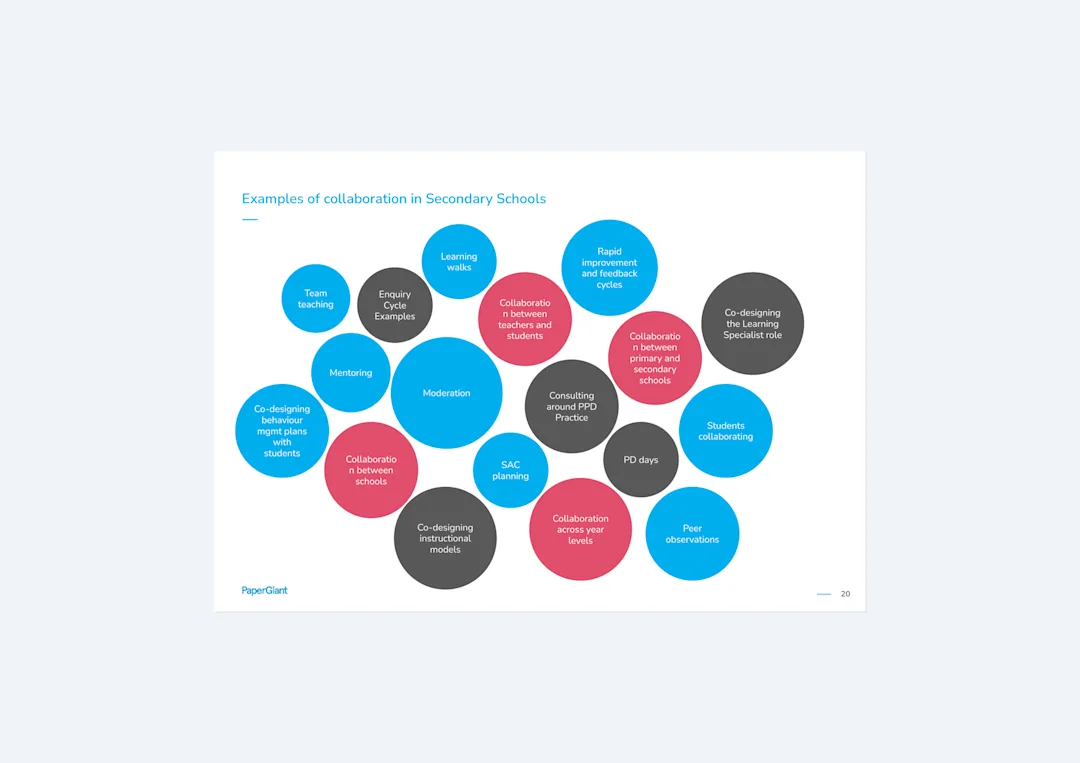
The range of collaborative activities teachers described across six Victorian secondary schools — from team teaching and peer observations to SAC planning and co-designing instructional models.
Five opportunities to strengthen support
Our research surfaced five clear opportunity areas for the Department. First, schools needed workforce planning support to think strategically about how new roles and structures fit their context. Second, teachers and principals needed a clearer narrative around the intent behind these policies — many understood the mechanics but not the purpose. Third, communication and influence practices varied enormously, with some schools finding creative ways to build buy-in while others struggled. Fourth, collaboration in secondary schools faced structural barriers like split timetables and part-time staff that required practical solutions. And fifth, Learning Specialists needed differentiated support depending on their school's size, existing structures, and stage of implementation.
When teachers collaborate, the students see it and feel it and so does the community. It gives a greater sense of security and builds support for the school and the kids.
— Victorian secondary school teacher